

Paper 001-2026 — BenZen’s first published insurance-data analysis.
About This Analysis
BenZen is a health-insurance media and technology company focused on how ACA Marketplace coverage works for people managing Type 2 diabetes. We work with public Marketplace plan data, carrier formularies, and standardized coverage documents to ask specific, checkable questions about how insurance benefits behave in practice.
This is our first published analysis. It is exploratory, not peer-reviewed, and it is scoped narrowly on purpose. We are publishing our methodology and limitations alongside our findings so the work can be evaluated on its own terms — and corrected if we get something wrong.
Abstract
Consumers comparing ACA Marketplace plans typically encounter premiums, deductibles, metal levels, and other headline plan characteristics. For people managing Type 2 diabetes, some plans also explicitly reference diabetes in their marketing names. This exploratory analysis examined whether those commonly visible signals identify the same plans that appear attractive when the standardized “Managing Joe’s Type 2 Diabetes” coverage example from the Summary of Benefits and Coverage (SBC) is added to the comparison.
We examined nine 2026 individual-market plans available in Dallas County, Texas, including four diabetes-branded plans. Patient responsibility in the standardized diabetes example ranged from $400 to $1,800. None of the four diabetes-branded plans had the lowest patient responsibility in the example, and substantial differences appeared among plans sharing the same metal level.
The findings suggest that commonly emphasized plan characteristics do not fully describe how benefit design applies to standardized diabetes care. This analysis is exploratory and is not intended to rank plans or predict an individual’s healthcare costs.
Key Finding
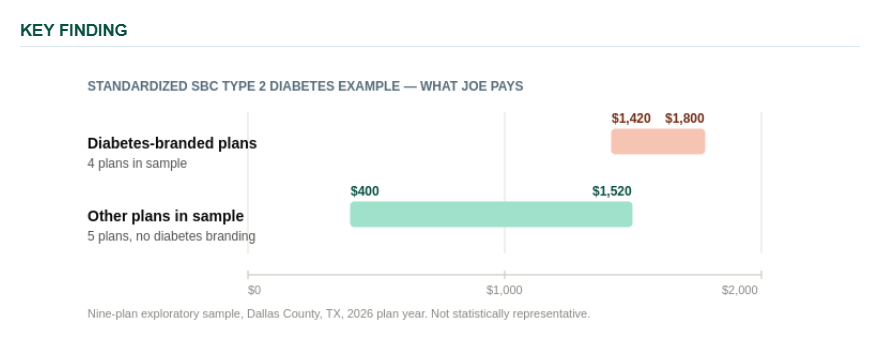
Every diabetes-branded plan in this sample produced a higher patient responsibility in the standardized diabetes example than the lowest-cost conventionally named plan. The plan with the lowest Joe responsibility carried no diabetes branding at all.
The Question
Shopping for health insurance usually begins with a familiar set of numbers: monthly premium, deductible, out-of-pocket maximum, metal level, and perhaps copayments for common services.
For someone managing Type 2 diabetes, those numbers matter. But they may not tell the whole story. Neither, it turns out, does the word “diabetes” printed on the plan itself.
Every Summary of Benefits and Coverage (SBC) includes standardized coverage examples designed to show how a plan’s cost-sharing rules apply to specific healthcare scenarios. One of those examples is “Managing Joe’s Type 2 Diabetes.”
That raises a simple question:
If a consumer with Type 2 diabetes shops ACA plans using the information normally emphasized during enrollment — including plans explicitly marketed toward diabetes care — would they identify the same plans that appear attractive when the standardized SBC diabetes example is added to the comparison?
We looked at nine 2026 ACA Marketplace plans available to consumers in Dallas County, Texas, to find out.
What Is the SBC Diabetes Example?
The SBC is a standardized document consumers can use to compare health plans.
Toward the end of the document are coverage examples showing how the plan might divide costs for specific medical scenarios. The diabetes example describes a year of routine in-network care for “Joe,” a person managing a well-controlled case of Type 2 diabetes.
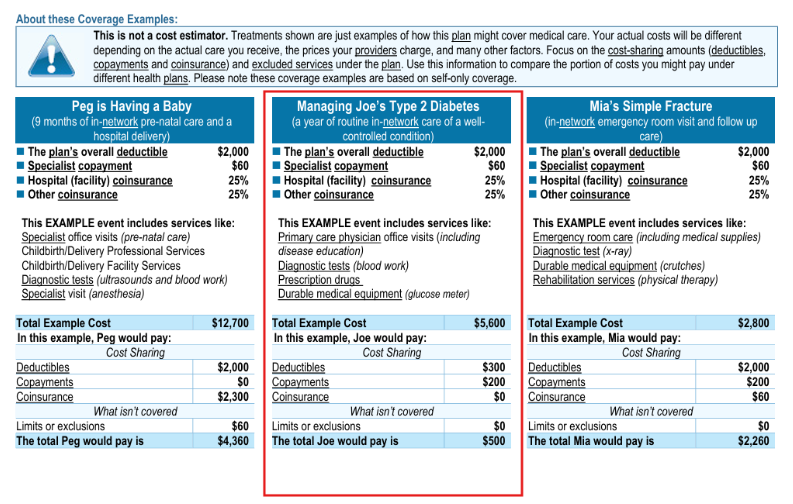
The Joe example as it actually appears in the UHC Gold Standard 2026 SBC — one of the nine plans examined in this analysis. Source: UnitedHealthcare of Texas, Inc., SBC document TX0018 EXTX26IF0278591_000, page 6 of 6.
The example includes primary-care visits and disease education, diagnostic blood work, prescription drugs, and a glucose meter. In the UHC Gold Standard SBC, the services have a standardized total example cost of $5,600.
The important number for our purposes is what Joe pays.
That amount reflects how the plan’s deductible, copayments, coinsurance, and other cost-sharing rules interact with the same standardized healthcare scenario.
The SBC specifically warns that the coverage examples are not cost estimators. Actual expenses depend on the care a person receives, provider prices, and other circumstances. Instead, the examples are intended to help consumers compare the portion of costs they might pay under different plans.
We therefore treated Joe’s responsibility as a standardized comparison measure, not a prediction of what a particular person with diabetes will spend.
How We Compared Plans
We examined nine individual-market plans available in Dallas County, Texas, for the 2026 plan year.
Why Dallas County. Dallas County was selected as an exploratory case study because preliminary review of the market showed sufficient variation to test the underlying question: multiple issuers, a mix of diabetes-branded and conventionally named plans, both Gold and Silver metal levels, and a range of deductible structures. That variation, not the eventual Joe results, is why Dallas was the starting market for this analysis.
This was not intended to be an exhaustive ranking of every plan available in Dallas County. We deliberately assembled an exploratory group containing different insurers, Gold and Silver plans, different deductible structures, and both diabetes-branded and conventionally named plans.
Four selected plans explicitly referenced diabetes or diabetes-focused care in their marketing names.
We first considered information commonly emphasized while shopping for insurance: gross monthly premium for a 40-year-old before premium tax credits; metal level; individual medical deductible; individual out-of-pocket maximum; and whether the plan explicitly referenced diabetes in its name.
We then added the amount Joe pays in each plan’s standardized Type 2 diabetes coverage example.
Using an unsubsidized age-40 premium gave us a consistent premium measure without introducing assumptions about income, household composition, or eligibility for premium tax credits.
Plan information was assembled from public Marketplace data, enrollment information, and carrier SBCs. Because Marketplace data and plan documents can change and plan variants do not always appear identically across sources, we matched the consumer-facing plan and corresponding SBC as closely as practical. One additional plan considered during research — a UnitedHealthcare Silver variant — was excluded from this analysis because we could not confirm with sufficient confidence that the plan-variant identifier and its corresponding SBC referred to the same product. We would rather report fewer plans accurately than include one we could not verify.
What We Found
| Plan | Diabetes-branded | Metal | Age-40 premium | Medical deductible | Joe pays |
|---|---|---|---|---|---|
| Oscar Gold Simple Diabetes Guided Care | Yes | Gold | $613.56 | $2,000 | $1,800 |
| BSW Diabetes Care Gold HMO 014 | Yes | Gold | $619.60 | $1,700 | $1,420 |
| BCBSTX MyBlue Health Gold 403 | No | Gold | $658.80 | $500 | $1,020 |
| UHC Gold Standard | No | Gold | $731.92 | $2,000 | $500 |
| UHC Gold Copay Focus | No | Gold | $748.99 | $0 | $400 |
| BCBSTX MyBlue Health Silver 405 | No | Silver | $761.37 | $1,500 | $1,520 |
| Cigna Connect myDiabetesCare Gold DFW | Yes | Gold | $787.18 | $2,500 | $1,520 |
| BCBSTX Blue Advantage Plus Gold 803 | No | Gold | $840.66 | $2,400 | $1,320 |
| Ambetter Enhanced Diabetes Care Silver | Yes | Silver | $941.14 | $5,000 | $1,420 |
Sorted by gross monthly premium — the order a consumer typically encounters while shopping. Gross premiums are before premium tax credits. Plan figures reflect the working 2026 comparison dataset and associated plan documents.
Carrier abbreviations: BSW = Baylor Scott & White · BCBSTX = Blue Cross Blue Shield of Texas · UHC = UnitedHealthcare
Read left to right, in shopping order: the two lowest-premium plans are diabetes-branded. Neither is the lowest-Joe-cost plan in the sample.
The immediate result is not that one of these plans is the “best” plan for diabetes. It is that the picture changes depending on what information we look at — and one of the sharpest changes involves the plans that name diabetes directly.
The Headline Finding: “Diabetes” in the Name Didn’t Predict the Lowest Cost
Four of the nine plans in our sample explicitly reference diabetes or diabetes-focused care in their marketing names. For a consumer managing Type 2 diabetes, those names may reasonably stand out during plan shopping.
Here is what Joe pays under each, in the standardized diabetes example:
- Oscar Gold Simple Diabetes Guided Care — $1,800
- Cigna Connect myDiabetesCare Gold DFW — $1,520
- BSW Diabetes Care Gold HMO 014 — $1,420
- Ambetter Enhanced Diabetes Care Silver — $1,420
The five plans in our sample with no diabetes branding at all ranged from $400 to $1,520 in the same standardized example — and the two lowest-cost plans in the entire sample, UHC Gold Copay Focus ($400) and UHC Gold Standard ($500), carry no diabetes marketing whatsoever.
Put plainly: in this sample, every diabetes-branded plan produced a higher Joe responsibility than the lowest-cost conventionally named plan. The plan with the lowest patient responsibility in the standardized diabetes example did not use diabetes branding.
That does not establish that diabetes-oriented plans provide worse coverage overall. A plan designed around diabetes could offer real value — disease management programs, care coordination, provider relationships — that Joe’s standardized example does not capture. Our finding is narrower than “diabetes plans are worse.” It is this:
In this sample, a diabetes-oriented plan name did not reliably identify the plan with the lowest patient responsibility in the standardized Type 2 diabetes coverage example.
For consumers who might treat a diabetes-oriented name as a shortcut for diabetes-specific value, that is a counterintuitive result worth examining more closely.
Premium Tells Us One Thing
If we begin with gross monthly premium, the same two diabetes-oriented plans that led the branding comparison also stand out here.
Oscar Gold Simple Diabetes Guided Care has the lowest premium in our selected group at approximately $614 per month. BSW Diabetes Care Gold follows closely at approximately $620.
But when the standardized diabetes example is added, Joe pays approximately $1,800 under the Oscar plan and $1,420 under the BSW plan.
Farther down the premium list, UHC Gold Standard costs approximately $732 per month, but Joe pays $500 in its standardized diabetes example.
UHC Gold Copay Focus costs approximately $749 per month, while Joe pays $400.
This does not mean that the UHC plans are better overall. It means that premium and standardized diabetes cost sharing are measuring different things.
The Deductible Doesn’t Tell the Whole Story Either
UHC Gold Standard provides a useful example.
Its individual medical deductible is $2,000. But Joe doesn’t pay $2,000 toward the deductible in the standardized diabetes scenario. He pays $300 toward the deductible and $200 in copayments, for total responsibility of $500.
The benefit design helps explain why. Under this plan, primary-care visits have a $30 copayment and specialist visits a $60 copayment, with the deductible not applying to those services. Prescription benefits similarly use copayments for several drug tiers, and listed Tier 1 insulin products are available at no charge through network pharmacies.
The $2,000 headline deductible is accurate. It simply doesn’t explain, by itself, how the plan handles the routine diabetes care represented by Joe.
Metal Level Doesn’t Settle the Question
Among the Gold plans in this exploratory group, Joe’s responsibility ranges from approximately $400 to $1,800.
All of them carry the same Gold designation.
Metal level remains useful information about the overall actuarial structure of a plan. But our comparison suggests it cannot substitute for examining how a particular benefit design applies to a standardized diabetes scenario.
What It Means During Open Enrollment
The pattern that emerged was straightforward:
Premium → deductible → metal level → diabetes branding → standardized diabetes example.
Each additional piece of information tells us something the previous one did not.
A premium tells us what maintaining coverage costs before subsidies. A deductible tells us about an important component of the plan’s cost-sharing structure. A metal level gives us a broader indication of how costs are divided between the insurer and covered population. A diabetes-oriented plan name can signal that an insurer has designed or marketed benefits toward people managing diabetes, but the name alone does not show how the standardized diabetes scenario is treated.
None of those measures necessarily tells us what happens when the same standardized set of diabetes services is run through the plan.
The SBC example does.
That doesn’t make it a complete answer. It makes it another useful layer of information that exposed differences not obvious from the headline plan characteristics we examined.
And unlike a proprietary diabetes score or an algorithm developed by BenZen, the underlying example already exists in a standardized insurance document.
The information was there.
The more interesting question may be whether consumers are being shown it at the point when it could help them compare plans.
Limitations
This is a small exploratory analysis, and its conclusions should be interpreted accordingly.
The nine plans were deliberately selected to examine contrasting plan designs. They are not a statistically representative sample of every Marketplace plan in Dallas County or the United States.
The standardized Joe example represents one specific pattern of routine care for a well-controlled condition. It does not capture every healthcare need of a person with Type 2 diabetes.
In particular, this analysis does not determine whether an individual’s specific medications are covered, what formulary tier they occupy, whether prior authorization is required, whether a preferred physician or endocrinologist participates in the network, or what an individual will actually spend over a year.
The diabetes-branding finding should also be read narrowly. “Diabetes” in a plan’s marketing name is a label, not a defined benefit category, and different carriers may use it to signal different things — a disease management program, a provider network, or simply a marketing choice. Four diabetes-branded plans is a small group, and this analysis cannot say whether the pattern holds outside Dallas County or outside this specific sample.
Premium tax credits were deliberately excluded from the premium comparison. Actual consumer premiums can differ substantially based on household and eligibility circumstances.
Finally, Marketplace plan information is not static. Plan information can change, different cost-sharing variants may exist under related plan identifiers, and CMS data, enrollment platforms, and carrier documents do not always present plan information in precisely the same way. One plan considered during research was excluded from this analysis for exactly that reason — we could not confirm with sufficient confidence that a specific plan-variant identifier and its corresponding SBC referred to the same product, so we left it out rather than publish a figure we could not verify.
Those are limitations of this analysis. They are also part of the problem we are interested in studying.
A Note on the Analysis
This is BenZen’s first published insurance-data analysis, and it is intended to be useful and transparent rather than definitive.
We made reasonable efforts to match the plans in this analysis with the appropriate 2026 source information and SBCs. Because Marketplace information can change and multiple sources may describe related plan variants differently, some discrepancies or errors may remain — if we identify a material one, we will correct it.
The standardized diabetes examples discussed here are not predictions of an individual’s healthcare expenses, nor recommendations to enroll in a particular plan. They are one additional source of information that may help consumers understand how plans differ.
What We’re Asking Next
This first comparison leaves us with a larger question:
Was Dallas unusual, or is this pattern widespread — particularly the finding that diabetes-branded plans did not lead on standardized diabetes cost sharing?
If that pattern holds beyond this sample, it would raise a broader question about how much weight consumers should place on diabetes-oriented plan naming when comparing coverage.
That can be tested.
The next step is to expand beyond nine plans: more insurers, more metal levels, more markets, and eventually more states, with enough diabetes-branded plans in the sample to say something more than “in this case.”
For now, the conclusion is narrower:
In this exploratory comparison of nine 2026 Marketplace plans in Dallas County, adding the standardized SBC Type 2 diabetes example revealed meaningful differences that were not apparent from commonly emphasized plan characteristics alone. None of the four diabetes-branded plans in the sample had the lowest patient responsibility in that standardized example.
For people managing diabetes, that information may deserve a more visible place in the plan-shopping process.
Methodology & Sources
Market: Dallas County, TX · Plan year: 2026 · Plans analyzed: 9
Premium basis: age 40, unsubsidized · Primary sources: CMS Marketplace data + carrier SBCs · Analysis: BenZen
Primary sources referenced in this analysis:
- CMS — Summary of Benefits and Coverage (SBC) and Uniform Glossary
- CMS Marketplace / Qualified Health Plan (QHP) Landscape data, 2026 plan year
- Individual carrier SBCs for the nine plans listed above (UnitedHealthcare of Texas, BCBSTX, Baylor Scott & White, Oscar, Cigna, Ambetter/Centene)
About BenZen Research
BenZen Research examines how health insurance works for people managing diabetes using publicly available Marketplace data, carrier documents, formularies, and other insurance information.
Our analysis is independent and non-peer-reviewed. This research is educational and does not recommend a particular health plan or predict an individual’s healthcare costs. Source information can change. Material corrections will be noted on the applicable research page.
Questions, source corrections, or data discrepancies can be submitted here.
BenZen is a registered trademark of HealthBenefits, LLC.